














What AIA Contracts Are and How to Manage Them
AIA contracts are standard in the building industry, and they link across the job site and beyond. Keeping track of them can be difficult, but digital contract management solves that problem.

Table of Contents
- What does AIA stand for?
- The purpose of AIA contracts
- When do I need an AIA contract?
- Types of AIA contracts
- Parts of an AIA contract
- Benefits of using AIA contracts
- Limitations of an AIA contract
- How to create an AIA contract
- Managing AIA contracts
- Why AIA contracts can be time-consuming and hard to track
- Automating workflows for AIA contracts
- Using a contract lifecycle management solution for AIA contracts
- Ironclad product features that help
- Why use digital contract management for AIA contracts?
- Streamline your AIA contract management
- Frequently asked questions about AIA contracts
Want more content like this? Sign up for our monthly newsletter.
Key takeaways:
Utilize AIA contracts as standardized frameworks that save time because they’re widely recognized across the construction industry and provide tested defaults for critical terms like payment structures and dispute resolution.
Recognize that AIA contracts require customization and legal review for each project, as certain clauses like retainage provisions may conflict with state laws or need adjustment for your specific situation.
Implement contract lifecycle management systems to automate workflows and maintain transparency across interconnected AIA contracts, preventing the average 8.6-11% contract value erosion caused by poor visibility and manual tracking.
Familiarize yourself with the AIA series structure to quickly understand contract context, where A-Series covers owner-contractor agreements, B-Series covers owner-architect agreements, C-Series covers consultant agreements, and D-Series provides exhibits and guides.
Ever tried to manage multiple construction projects without feeling like you’re drowning in paperwork? One project starts with a simple owner-contractor agreement, then suddenly you’re tracking amendments, subcontractor forms, and vendor agreements that all reference each other in an endless chain.
AIA contracts are designed to bring order to this chaos, but managing them across teams and projects creates its own set of challenges. The good news is that modern contract management tools can turn these interconnected documents from a coordination nightmare into a strategic advantage.
What does AIA stand for?
AIA stands for the American Institute of Architects. If you’re in construction, architecture, or have ever done a major renovation, you’ve probably come across their documents. They create standardized contract templates that are widely used across the industry. Think of them as the go-to playbook for defining roles, payments, and timelines on a project.
The AIA has been around since 1857, and over the decades, their contracts have become the de facto standard across an industry with over $2.1 trillion in annual spending. When someone mentions an “AIA contract,” they’re referring to one of the many document templates the organization publishes and regularly updates to reflect current industry practices and legal requirements.
The purpose of AIA contracts
AIA contracts serve one core purpose: they create predictable, fair processes across an unpredictable industry. Every construction project faces unique challenges, but AIA forms provide standardized frameworks that protect all parties involved.
The contracts cover all stages of design and building. Each form is fully customizable but uses industry-tested defaults for critical terms. For example, they handle payment structures in a consistent way—process billing happens as work unfolds, and retainage (the amount held back until project completion) is negotiable rather than fixed, giving you flexibility while maintaining structure.
These contracts benefit from widespread recognition in the industry. When someone says “I’m using an AIA contract,” experienced professionals immediately understand the basic framework. The most commonly used forms include the A401 Standard Form of Agreement Between Contractor and Subcontractor for commercial projects, while homeowners typically sign an A101 Owner-Contractor Agreement.
This familiarity creates certainty in an otherwise uncertain process.
When do you need an AIA contract?
You need an AIA contract whenever you’re managing a construction or renovation project. This applies to both residential homes and commercial buildings.
Here’s what typically happens: you start with one primary contract, then additional agreements multiply as the project progresses. Each new contractor, subcontractor, or vendor relationship requires its own documentation.
AIA contracts offer particular value to small businesses and sole proprietors—99.8% of construction firms are small businesses. Rather than negotiating terms from scratch, you can rely on standardized frameworks the industry already knows and trusts.
Types of AIA contracts
The AIA doesn’t just have one contract; they have a whole library organized into different “series” based on who is involved and what the project is. You don’t need to know all 200+, but it helps to understand the main families:
A-Series: These are the agreements between the owner and the contractor. This is one of the most common types you’ll see.
B-Series: These documents cover the agreement between the owner and the architect.
C-Series: This series is for agreements with other consultants, like engineers or specialists, where the architect isn’t the primary contact.
D-Series: These are miscellaneous documents that serve as exhibits or guides for the other contracts.
Knowing the series helps you quickly understand the context of an agreement before you even read the first clause. Each series is designed to work together, so an A-Series owner-contractor agreement will reference the same general conditions as a related B-Series owner-architect agreement.
Parts of an AIA contract
Every AIA contract is built around core components that define the business relationship. A typical AIA subcontract contains:
Description of work to be done
Amount to be paid
How payment is made
Whether part of the payment is held until the work is completed
Terms and procedures for payment
Handling disputes
Contract complexity varies based on project scope. AIA contracts cover nearly all parts of the building process, from simple agreements to comprehensive 90-page documents. Smaller projects use simpler forms with fewer sections.
Benefits of using AIA contracts
You might be wondering why everyone defaults to AIA contracts instead of just writing their own. It really comes down to a few practical benefits.
First, they’re standardized and widely accepted. When you send an AIA contract, the other party likely already knows the general terms, which can speed things up. There’s less back-and-forth because you’re starting from a place of common understanding.
They also cover most of the bases, which reduces the risk of forgetting a key term. It’s a reliable foundation that saves you from having to reinvent the wheel for every single project. And because they’re updated regularly by the AIA, you can be confident the language reflects current legal standards and industry best practices.
Limitations of an AIA contract
Of course, AIA contracts aren’t perfect for every situation. The biggest tradeoff you’ll face is between standardization and customization—using a standard contract increases reliability but decreases flexibility.
You also have other options to consider. ConsensusDocs and the National Association of Homebuilders produce their own templates. The AIA contract remains the industry standard, but it’s not your only choice.
There are practical cost considerations too. Minor charges for buying and amending contracts add up over time. The contracts also grant architects significant power in dispute resolution—you may prefer a different mediator depending on your specific situation.
Finally, some standard clauses face legal challenges. For instance, the retainage clause allows contractors to hold back money from subcontractors until job completion. This practice is now illegal in several states, so you’ll need to modify those sections accordingly.
How to create an AIA contract
Getting started with AIA contracts is straightforward. You can purchase contracts directly from the AIA, buying them singly or through a yearly license. Their website is searchable, and you can see the documents before purchase. Once you have filled in the document and made any necessary modifications, run that contract by a construction lawyer.
Managing AIA contracts
Here’s where things get complicated. Managing multiple AIA contracts on a single site creates a complex web of interconnected documents. Amendments, new projects, and additional contractors all generate new contracts that reference previous agreements.
Here’s the challenge: new contracts often reference older ones. Those older contracts may reference even earlier documents. Understanding any single agreement requires tracking down its entire reference chain.
This becomes like following breadcrumbs through an increasingly complicated trail. And when you lose track of those breadcrumbs, it costs you—organizations lose an average of 11% of contract value after signature due to poor visibility and management, according to a recent World Commerce & Contracting study.
Why AIA contracts can be time-consuming and hard to track
The complexity starts with the contracts themselves—each AIA contract often references other contracts, creating interconnected webs of agreements. When you’re managing multiple projects, each with its own set of contracts, you’re essentially juggling several of these complex webs simultaneously.
Separate systems
The system fragmentation problem multiplies across departments. Take your initial contract tangle and disperse it across five departments. Each one uses a different system.
Finance imports contracts into proprietary forecasting software. Supply Chain Management creates PDF reports for manufacturing disruption planning. Accounting enters data into payment databases. Legal works in DOCX format.
Consolidating these scattered documents becomes a significant undertaking. It requires hours of manual labor. You may need to manually retype or scan information across systems.
Isolated process
Once each department has copies of the AIA contract, they do their own thing with it. Each department’s work is hidden from other departments until someone does an audit. Then they get a crash course on how Finance treats its documents. Working in isolation, different departments may develop conflicting ideas of what the contract means.
Lack of transparency into the contract process
Across a large or medium organization, separate offices often work in isolation. They take care of their own work and ignore what others are doing. When a contract is being created, people who legal thinks should be notified are contacted. But those people are not the only ones affected.
Other affected departments may not even know a new contract is pending until it is presented to them as a finished document. Good advice based on experience doesn’t get incorporated because it never had the chance. Concerned parties cannot even know if the contract covered their concerns within the opaque process. This lack of transparency into other areas of the business can hurt the bottom line — poor contract management causes average value erosion of 8.6%.
Automating workflows for AIA contracts
The solution to these coordination challenges lies in automation. You can solve these problems by using AI contract lifecycle management and automating workflows for AIA contracts. It’s a shift that’s already well underway across the industry, as 69% of legal professionals now use AI for legal work, according to The State of AI in Legal 2025 Report. Everything goes into one system that integrates seamlessly with your other tools. Everyone can see what is happening and take part when they need to.
How templatized workflows can help simplify the process
Templatized workflows are often the first step in transforming your contract management from manual tracking to automated coordination. When an AIA contract enters your system, you fill standard fields with project-specific information. Ideally, the relevant parties are automatically alerted when they need to provide input or signatures.
After a few contracts go through the system, its AI learns and replicates the workflows you need. It will generate new workflow templates for you that show where and when the AIA contract needs to be checked or signed.
Using a contract lifecycle management solution for AIA contracts
AI contract management is an approach that follows the contract from being a new idea through its creation and fulfillment. After a contract is fulfilled, it becomes a valuable asset, serving as reference material for future agreements. At every stage, interested parties can read it and use it for planning in their own departments.
All-in-one solution
Ironclad’s program is a single piece of software. It uses DOCX for all its documents so they can export into the most used word processing programs. We’ve integrated some of the most used programs into it. These programs include DropBox, DocuSign, Google Cloud Storage, and more. We also have a feature that lets you incorporate your own favorites if we have not connected them already.
One source of truth
Once, you had five departments with five final documents that were not the same anymore. Now you have one central AIA contract set for everyone to see and use. The program funnels contract changes into the right processes and notifies everyone affected. Anyone with questions can access the contract in Ironclad and find what it says.
Full transparency into the process
Meanwhile, anyone with access can look in on the contract. They can check their past work and see who is currently working on the contract. They can correct errors and automatically notify all the people who need to know. Everyone’s wisdom can enter the contracting process and create a better contract.
CLM product features that help
CLMs like Ironclad are typically packed with features to help you better manage your AIA and other contracts. While one system for all departments is a major draw, let’s look at some other important features.
Workflow designer
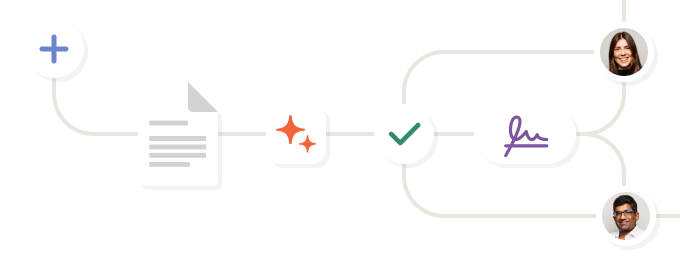
A “workflow” for a contract starts at contract creation. You begin with a drag-and-drop system where you design a workflow. You populate the contract with the terms you need and attach all the people involved in the correct order of approval for automated approval routing. Once the workflow is set, the system guides the contract through each stage, ensuring everyone acts at the right time.
Repository
A central document repository holds all the contracts. People can access any contracts they need from there. The repository, however, should do much more. It allows you to ask questions about current and past contracts.
When is the delivery due to Business G? How many deliveries have we made to them on this contract? On all contracts? Has the price changed over time? Does this price match those of other vendors? Can we estimate future business? The repository is not just a box holding contracts; it should be a contractual analysis system that helps you find key data to negotiate better terms and identify future business opportunities.
Why use digital contract management for AIA contracts?
Keeping track of your documents is the first reason to use digital contract management. The smooth flow of contract work throughout your business is another. Digital contract management puts your contracts to use analyzing business processes and to create better contracts in the future.
Streamline your AIA contract management
AIA contracts are designed to bring order to complex projects. But managing them—especially when you have dozens or hundreds across different projects—can quickly become a job in itself. The key isn’t just using the right templates, but having a system to keep them all connected, visible, and moving.
This is where choosing the right contract management software becomes essential, turning your static documents into a dynamic system that supports your business instead of slowing it down. If you’re ready to see how you can get a better handle on your AIA contracts and the entire contracting process, request a demo today.
Frequently asked questions about AIA contracts
What does AIA stand for in construction?
In construction, AIA stands for the American Institute of Architects. They are the organization that creates and publishes the standardized contract documents widely used in the industry.
Who can use AIA contract templates?
Anyone can purchase and use AIA contract templates, but they are primarily designed for owners, architects, contractors, and subcontractors involved in construction projects. You don’t have to be an AIA member to use them.
Are AIA contracts legally required for construction projects?
No, using AIA contracts is not a legal requirement. They are simply industry-standard templates that are popular because they are comprehensive and familiar to most parties. You can use custom contracts, but AIA documents often provide a reliable starting point.
How much do AIA contract templates cost?
You can purchase individual AIA documents directly from the AIA, with prices varying per document. They also offer annual licenses that provide unlimited access to their library of contracts, which can be more cost-effective for businesses that handle many projects.
Can AIA contracts be customized for specific projects?
Yes, absolutely. AIA contracts are fully customizable. While they provide standard terms, they are meant to be edited to fit the specific needs, budget, and timeline of your project. It’s common practice to modify them; always have a lawyer review any changes.
Ironclad is not a law firm, and this post does not constitute or contain legal advice. To evaluate the accuracy, sufficiency, or reliability of the ideas and guidance reflected here, or the applicability of these materials to your business, you should consult with a licensed attorney. Use of and access to any of the resources contained within Ironclad’s site do not create an attorney-client relationship between the user and Ironclad.